Did you know that there are actually other books out there besides mine? It’s true! All different kinds! To prove it, here are five reviews of books I’ve read in the past year.
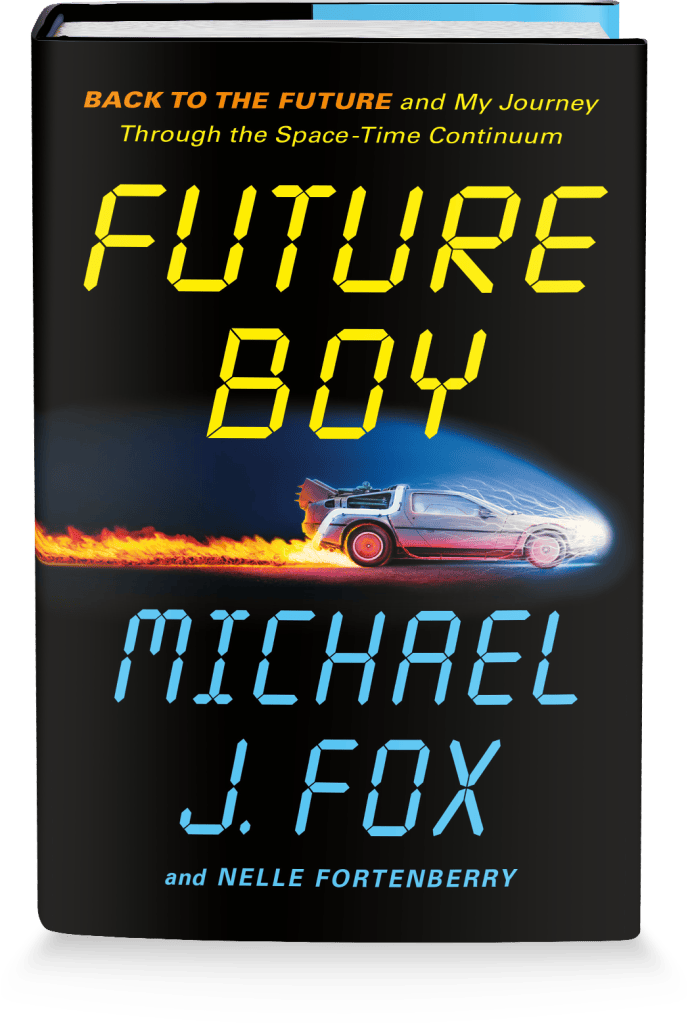
Future Boy: Back to the Future and My Journey Through the Space-Time Continuum by Michael J. Fox and Nelle Fortenberry
(5 out of 5 stars)
Like its author, Future Boy by the quintessential Michael J. Fox is super fun and super short. In his mini-memoir, Fox chronicles his time making the movie Back to the Future, which I’d argue is the best movie of the ‘80s (alongside Ghostbusters). Even though I knew this already, I’m still amazed that Fox was simultaneously filming the T.V. series Family Ties while making this movie. What a year Fox had in 1985! He starred in one of the most popular television shows at the time, he had the lead role in the number-one movie of the year (and one of the best movies of the decade—or any decade), and he was even the star of the cult classic Teen Wolf, which I still feel is somewhat underrated. Super fans like me won’t be surprised by some of the reveals here, including the fact that Eric Stoltz was originally cast as Marty and the production team already shot half the film with him before replacing him with Fox when they realized his performance wasn’t right for the role. Stoltz had a more serious acting background, while Fox was used to the comedic rhythms of a T.V. sitcom. (Side note: I don’t actually blame Stoltz; someone should’ve taken him aside and said, “Um, you realize we’re making a comedy, right?”) Then again, even casual fans know this trivia about the actor switch. (It was even a minor plot point in that Flash movie with Michael Keaton.)
I realize the book’s main raison d’être was the original film, but I wish Fox wrote anything at all about the two sequels. (At only 150 pages, not counting the long Acknowledgments section, the book could have used some padding out.) Still, there’s enough fun tidbits here to recommend the book, like how the cast initially treated him when he arrived and learning just how weird—and at odds with the director—Crispin Glover was. (There’s a reason, beyond his outrageous demand for a salary on par with Fox, that they replaced him in the sequels.) And the scene where Fox describes his confusion of which role he was playing (he was looking for Marty’s camcorder on the set of Family Ties) was hilarious—and understandable, seeing as how he was going on 3 to 4 hours of sleep a night, max. Of course, it’s sad to know what became of Fox, having to step away from acting to deal with his Parkinson’s disease, but this book is a nostalgic time capsule of a period when anything seemed possible and DeLoreans could travel in time.
Welcome to Your Life: Love, Death & Tears for Fears by Roland Orzabal
(4 out of 5 stars)
I’ve been a huge Tears for Fears fan ever since “Everybody Wants to Rule the World” ruled the radio in the mid ‘80s. In fact, I’d argue that it was the song of the decade. So I was eager to dive into the long-awaited memoir of the songwriter and cofounder of the band himself, Roland Orzabal. In the Introduction that doubles as a warning, the reader learns that this book is a self-described “Astrological Memoir,” with references to complicated constellation charts and how the various signs play havoc with our lives. Honestly, I didn’t understand most of those zodiacal tangents, so while I’m sure Orzabal wouldn’t approve, I simply chose to ignore those bits. I will say, however, that I started noticing more of his allusions to astrology in his lyrics after reading this book (“The sun and the moon/The wind and the rain”). Also, Orzabal tends to blame everything on the zodiac, even saying he was being very egocentric at a certain point in his life because his Saturn was rising in the ninth house…or something. I wanted to tell him, “You know, it’s okay to take personal responsibility and not blame everything on the planets.” Having said that, I’ve noticed there have been times in my life when I tried my hardest and yet still failed. Then there were times I hardly tried at all and was successful. Was the motion of the planets involved in any of that? Who knows?
After a prologue involving the encroaching madness of his late wife, Orzabal details the trauma he endured during his tumultuous childhood, but this shouldn’t be a surprise to the man who helped form a band named “Tears for Fears” and whose songs were mostly inspired by Primal Scream therapy. I give Orzabal credit for trusting his reader to reveal so much of himself. At one point, he goes on about his mother’s beauty, who had worked as a burlesque stripper, even going so far as to describe her breasts. I would say “Paging, Dr. Freud,” but most TFF fans know he was an acolyte of therapist Arthur Janov, the founder of Primal Scream therapy himself.
To be honest, I was impatient to flip to the section of when TFF got big, but this is a problem I’ve had with most celebrity memoirs. I don’t really care much about the childhood stuff (says the author who wrote two novels, Danger Peak and Déjà View, about the joy and trauma of childhood, respectively) and want to fast-forward to “the good stuff” of the career highlights, so you can imagine how anticlimactic I found it that the big hits off their multiplatinum smash Songs From the Big Chair were written in a month (with some studio noodling in the months that followed). And I agree with Orzabal’s band partner Curt Smith that the album should’ve been titled The Working Hour. Not only is it my favorite TFF song, but it at least makes sense. It took me decades to learn, thanks to this book, what the hell “Songs From the Big Chair” even means, and who could’ve guessed that it was (Spoiler Alert!) a reference to an obscure Sally Field movie?
I was most surprised at Orzabal’s harrowing account of being addicted to the sleeping pill Ambien, something I was unfortunately able to relate to, though mine was a different sleeping medication. I always thought of Orzabal as being a clean-cut, serious musician who primarily focused on his music and never dabbled in drugs, but it’s time to put that childish, naïve assumption to rest. Everyone has problems, and everyone needs something to deal with those problems. The real issue is what you reach for to solve those problems.
Overall, I found this peek behind the mad genius of one of my favorite bands—not just of the ‘80s, but of all time—fascinating. Now when will we get to read Curt’s side of the story?
Batman: Resurrection by John Jackson Miller
(4 out of 5 stars)
Tim Burton’s first Batman movie was so influential to me, I gave it a shoutout in not one but two of my novels, Danger Peak and Déjà View, so when I heard that there was a book continuing Burton’s world that was officially endorsed by both Warner Bros. and original executive producer Michael Uslan, I snapped it up—albeit a few years after it had already been published. (Despite being an author myself, I’m slow in receiving news of the literary world.) I was immediately impressed with author John Jackson Miller’s grasp of the world that Burton, production designer Anton Furst, and actors Michael Keaton, Jack Nicholson, et al. had created—particularly in getting the right voice of the characters, though my Bruce Wayne wouldn’t have been so skittish and unsure of himself at times, almost acting like Clark Kent in certain scenes. Also, it was obvious Miller wished he could write for The Joker—despite the slight inconvenience that he dropped dozens of stories to his demise at the end of the first Batman film. (Over 30-year-old Spoiler Alert!) Without giving too much away, Miller gets to have his cake and eat it, too. And I loved the welcome return of snarky reporter Alexander Knox and beautiful photojournalist Vicki Vale. I hadn’t realized how much I missed them. It was like greeting old friends, and at the end of the novel, as they said their goodbyes to Bruce, I almost shed a tear.
At many places in this book, I felt just like that excited 12-year-old boy again in a movie theater watching Batman for the first time, especially when he whipped out his new gadgets and vehicles like The Roost and The Alpha Bat. I would’ve given this book a higher rating, but at over 400 pages, I felt the story dragged at times. I have an odd rule that a book shouldn’t be longer than 450 pages unless it’s a masterpiece, and this book almost broke that rule. Still, this was a fun caper that Miller cooked up for ‘89’s Batman. I could picture Michael Keaton donning his cape and cowl, and at certain points I wished that Burton had made this movie in between Batman and Batman Returns. Alas, that will never be, but at least we have this book.
Jurassic Park by Michael Crichton
(5 out of 5 stars)
Despite watching the original Jurassic Park a million times (it’s my wife’s favorite movie), I had never read its source novel by Michael Crichton. (Most readers like reading the book first; I’m the opposite.) I finally got around to it and was surprised at how different it was. Of course, I should know by now that movies aren’t books, and there are always going to be differences between them, but for one thing, I wasn’t prepared with how slow the book begins. It opens with both an Introduction and Prologue and only hints at the carnage to come. If you knew nothing at all about this story, you might not even know it’s about dinosaurs. It also takes forever to introduce the main characters. I kept impatiently wondering, “Where’s Dr. Grant and Ellie Sattler?” Also, John Hammond is less of a jovial Santa Claus figure like he was in the movie and more of a capitalist villain undone by greed. And without giving too much away, some characters who died in the movie live in this one, and some who lived in the movie die in the book.
These differences didn’t bother me except for the character of the little girl Lex. She’s pretty ineffectual throughout the entire novel, only screaming and crying for help from her brother Tim. Her baseball skills that she’s introduced with don’t even come into play (see what I did there?) throughout the book. And Tim is practically a genius at everything. He knows all there is to know about dinosaurs, like in the movie, but he even rivals Dr. Grant’s knowledge at some points. He’s always helpful with getting him and his sister out of a jam, and, unlike in the film, he’s the one who saves the day turning the park system back on with his computer skills. I’m glad they gave those skills to Lex in the movie, so she had something to do besides complain that she’s tired and hungry all the time. (Side note: The little computer graphics representing the system’s console throughout the book was a nice touch. It gave the book a visual flair without using actual illustrations.)
I realize that I’m spending most of this review comparing the differences between the movie and the book, and I guess that’s because we all know the story by now. But what a story. I think we forget how ingenious Crichton’s idea truly was when it was introduced over 35 years ago: bringing dinosaurs back to life with DNA from the dino blood inside fossilized mosquitos. He may have borrowed this idea from some paleontologists (it’s unclear what he gleaned from scientists in the Acknowledgments), but it’s still a whopper of an idea. Of course, his writing is also exceptional and highly detailed with scientific underpinnings that make the reader think, “This COULD actually happen.” And once the plot gets going, the book is action packed and hard to put down. It’s clear why Spielberg rushed to get the movie made over three and a half decades ago.
Some strange idiosyncrasies of Chrichton’s writing is to have a character explain something to another character (whether about dinosaurs, chaos theory, etc.), and then the narrator takes over as if the character is still speaking. I would sometimes get confused and not notice that the quotation marks were gone because these paragraphs would speak as one voice. Another quirk is to add line breaks to a scene for no discernible reason. For example, Dr. Grant would be stuck in a tight spot, and then there’d be a dramatic line break. The reader would be forgiven for thinking the story is moving on to another scene or character, but no. We’re still in the same situation with Dr. Grant. Curious.
Anyway, if you can’t tell, I highly recommend the book, but recommending Jurassic Park by now is like saying, “Hey, there’s this really cool sci-fi movie you should check out called Star Wars! Trust me; it’s a good one!”
Although Of Course You End Up Becoming Yourself by David Lipsky
(5 out of 5 stars)
I decided to read Although Of Course You End Up Becoming Yourself because I’m a huge fan of the film The End of the Tour, which of course was based on this book. Author David Lipsky, a former Rolling Stone journalist, interviews and follows the brilliant, late Gen-X author David Foster Wallace at the (you guessed it) end of his book tour for his massive (and massively influential), 1,000-page novel Infinite Jest. After sizing each other up, the duo first dukes it out intellectually in a kind of one-upmanship of who can say the cleverest quip, catch the other off guard, and basically just impress the other author the most with their wit and wisdom. But slowly, over the course of the tour (and book), the mental joust gives way to a mutual understanding and, even, admiration. And while Wallace clearly wasn’t as affected as Lipsky was from their meeting, Lipsky leaves the tour a changed man—and, dare I say, a better one.
I loved this book (and the movie) because it covers a topic most don’t. Most people don’t know what it’s like to write a book and simultaneously feel that sense of pride and accomplishment but also jealousy of the other authors who’ve accomplished way more than you. I basically feel this strange, toxic brew of emotions every day. It ain’t fun! But reading this book helped. It was a tonic on my nerves, and I’ll know in the future, I’ll need to pull this book out again to visit the doctor. It’s a must read.
***
In other MTP news, here’s the book trailer for my new coming-of-age/romance novel Is There Life After College?
It’s not very fancy, but at least I didn’t use AI this time. The trailer is already on the book’s homepage.
***
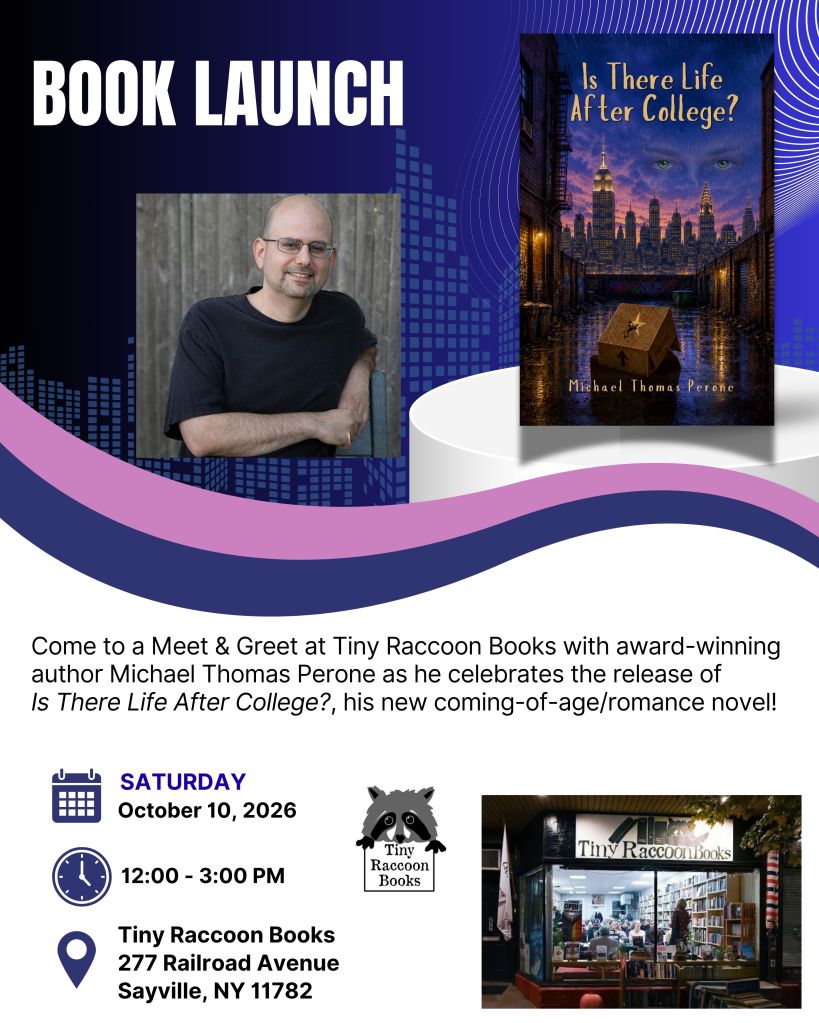
In other, other MTP news, my second book launch party for Is There Life After College? is this weekend! Tiny Raccoon Books in Sayville, NY, will be hosting me for a Meet & Greet on Saturday, October 10th, from 12 to 3 p.m. (It’s right across the street from the Sayville LIRR station.) I’ll be signing discounted copies of my books, answering any questions, and taking requests for karaoke selections. I threw that last one in to see if you were paying attention. For more information, see the flyer below.
Until next blog, same MTP time (usually Thursdays), same MTP channel (this website).
MTP
P.S.: Next blog: A surprise!
P.P.S.: The Danger Peak audiobook is available!
P.P.P.S.: Is There Life After College? is now available on Amazon and Barnes & Noble:

