Did you guys know I’m on Goodreads? It’s true! Check out my Contact page! I don’t just post stuff about my books; I also read and review other books. I know it’s hard to believe, but there are actually other books out there besides mine! And many of them are good! Reading is fun, y’all. I guess what I’m trying to say is, “Hooked on Phonics worked for me.” Here in no order is an assortment of random reviews I’ve written over the past year, with a star rating (out of 5) assigned to each book. The first one is actually a book I was reading for a year and a half. Find out why below!
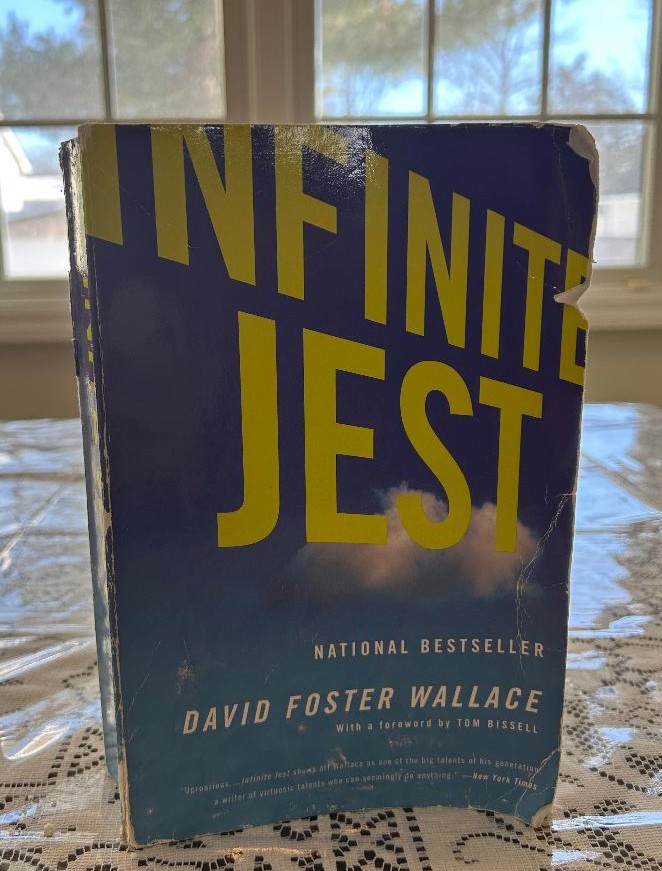
Infinite Jest by David Foster Wallace: 4 Stars
Infinite Jest is probably the most challenging book I’ve ever read in my life—a book so complicated (and long), it not only has footnotes (and hundreds of them), but even some footnotes have footnotes. This book has been on my bucket list since The End of the Tour and Liberal Arts became two of my favorite, semi-recent movies. The End of the Tour is about, well, the end of the book tour taken by David Foster Wallace (played by How I Met Your Mother’s Jason Segel) for Infinite Jest with a jealous journalist from Rolling Stone who follows him to chronicle the story played by the inimitable character actor you love to hate, Jesse Eisenberg. They discuss the plot of Wallace’s book and its themes, and their dueling conversation was fascinating to me and piqued my interest in reading the actual book. The book is a minor plot point in Liberal Arts (they don’t even mention the title), but it also prompted me to finally crack open the over 1,000-page Infinite Jest. More like Infinite Read, amirite? (Ba-dum tish.) Liberal Arts also happens to star (and be directed and written by) another How I Met Your Mother alum, Josh Radnor, but I digress.
So, would I recommend Infinite Jest or not? First of all, I’ll never be able to write a book as brilliant (or long) as this one. Wallace has a beautiful way of capturing nature and the nuances of everyday life that’s downright poetic. For example, he describes a window with “an oval flaw that’s casting a bubble of ale-colored autumn sunlight.” Or read how he beautifully describes a rainstorm in the city: “(She) can hear the rain’s thup on tight umbrellas and hear it hiss in the street, and can see droplets broken and regathering on her polyresin coat, cars sheening by with the special lonely sound of cars in rain, wipers making black rainbows on taxis’ shining windshields.” The “lonely sound of cars in rain” is such a perfect observation; I wish I could write a rain scene like that.
I also love the idea of this book: Someone films a movie so seductive and addictive (they call it “The Entertainment”) that people get hooked watching it until they die (hence the title of the book). That’s something that’s eerily prescient as Wallace wrote this book over a decade before streaming took over our lives and the concept of “binge watching” didn’t even exist. He also predicted the unholy marriage of televisions and computers with his “TP devices” or “teleputers.”
Having written all this, was this book an enjoyable read? For starters, the story hops all over the place. First you’re following young athletes at a tennis academy, then you’re at a drug rehabilitation center, and sometimes you’re—quite bizarrely—following the exploits of a pair of bumbling spies, one dressed in drag for some reason. (I guess for comedic relief?) Interwoven throughout are hundreds of footnotes giving you insanely detailed background and biographical information on specific plot points and certain characters (or sometimes just explaining all the acronyms Wallace seemed so fond of). Also, the paragraphs are packed with a plethora of proper nouns (alliteration!) that made the reading that more difficult.
To explain what you’re getting into with this book, there’s a chapter that seems to never end following one character waiting for a drug that may or may not arrive from his would-be dealer. He obsesses over whether the person will come, and, if so, he promises it will be the last time he uses the drug. This is not a bad idea for a scene, but it literally goes on for pages and pages and becomes repetitive fast. Then it repeats itself some more. Maybe the repetition was the point? To really drill home how obsessive the character is and how hopeless he feels? (I felt pretty hopeless that the chapter was ever going to end.) Maybe I’m not smart enough to get the point?
At times, it felt like the ghost of Wallace was taunting me, saying, “I dare you to finish this book!” There’s no question that this is a difficult book to read, and I’m not just talking about its famous length, though that’s obviously considerable. There’s no clear narrative or main character; surprisingly little dialogue for such a large book; the timeline jumps back and forth between “subsidized years” (e.g., The Year of the Adult Depends Undergarment, The Year of the Whopper, etc.), which is amusing but gets old fast and only leaves the reader (or at least me) bewildered; there are hundreds of the aforementioned footnotes, some of which go on for pages in tiny print (and yes, I read every one); and the text is filled with an alphabet soup of arcane acronyms to keep track of.
Honestly, reading this book felt more like work than fun. Every time Wallace peppered his lengthy sentences with those acronyms that I sometimes had to look up or just guess at, I thought to myself, “Am I going to get quizzed on this?” It took me longer than I care to admit that “E.T.A.” stood for “Enfield Tennis Academy.” (Y’know, because EVERYONE knows that acronym, right? No, I’m not bitter at all.) Finally, there are some single sentences that go on for literally two pages. I’m sorry, but where I come from, that’s called a “run-on sentence.” It was occasionally hard to bookmark this novel because I couldn’t find the ending to a sentence I was reading.
This book sometimes reads like a series of short stories with only a tenuous connection between them. For my own sanity, I decided that Hal, the teenaged prodigy at Enfield Tennis Academy (E.T.A.), was the main character. Now, to be clear, he definitely isn’t the main character (there IS no main character), but he’s the one I found most interesting, probably because I identified with him the most.
While there isn’t really a coherent story, there are themes interwoven throughout, namely the American need to be the most successful in your chosen field. I know I can relate to that, regarding my writing. What is it about us and our culture that we go to any cost and pay any price for a fleeting snatch of success? As the book points out, success is mostly a mirage anyway. I just wish Wallace tied up his themes in a pithier way. I’m not saying it had to be a pamphlet, but even a 500-page novel, half the length he chose, would have sufficed.
As I said (er, wrote), much of the writing is sublime, but overall, the book left me hungry for a clear story I could follow. For me, it all boils down to the famous saying, “Just because you can, doesn’t mean you should.” In other words, just because Wallace could write a gargantuan novel doesn’t mean it was necessary. Did this book really need to be over 1,000 pages and include hundreds of footnotes? I think the obvious answer is “No.” I’m reminded of an old review from the now digital-only magazine Entertainment Weekly on Charlie Kaufman’s enigmatic film Synecdoche, New York (I’m paraphrasing from memory here): “It’s like trying to solve a puzzle with a thousand pieces, and just before you snap the last piece into place, someone dumps a thousand more pieces on top.” Still, there’s no denying the virtuoso literary artistry Wallace displays here (hence the relatively high 4- out of 5-star rating). It’s peerless and unmatched, and there’ll probably never be another writer like Wallace. But I’m also never going to read this book again.
TL;DR: Gorgeous descriptions, but where’s the story?
P.S.: It took me a year and a half to read this book. In that time, I wrote two books: The Electric God and Other Shorts and a forthcoming romance novel. I think I may be prouder of myself for having finished reading Infinite Jest than writing those books.
Eternally Electric: The Message in My Music by Debbie Gibson: 4 Stars
(Talk about something completely different.)
I was a huge Debbie Gibson fan when I was a kid (and still sorta am). I had all her albums and even had her poster on my bedroom wall. (Yes, she was a bit of a childhood crush, but I was more impressed with her musical talent than any physical attributes, though no one would believe me.) And it was an extra bonus that she grew up 20 minutes away from me on Long Island. (At the time, I thought every famous musician came from Long Island, like Billy Joel.) So when I heard she wrote a long-awaited autobiography, I immediately snapped up an autographed copy.
You can imagine how thrilled I was when she opens (and closes) the book with her reflections on her Town Hall concert on July 26, 2024, because I was actually at that concert! And I loved hearing the behind-the-scenes stories of making her classic albums Out of the Blue and, my favorite, Electric Youth. (The book is named after that latter album, after all.) I would’ve liked to hear more about her writing process, but I suppose it’s hard to put something like that into words, since songwriting is more like magical channeling than logical reasoning. (I’m not saying I’m a big musician like Gibson, but I used to be in a band, so I know something about the process.)
Unfortunately, after chronicling her rise to fame and somewhat fall from the public eye, she gets bogged down into details of her life that only her die-hard fans would appreciate. For example, did she really need to dedicate half a chapter to her run in the show Gypsy? In other words, the book can be self-indulgent at times. (But what memoir isn’t?) I lost count of how many times she referred to herself as a “pioneer” for having done something, at one point almost singlehandedly crediting herself for the reason pop stars are now cast in Broadway musicals. Gibson is also guilty of self-flattering hyperbole, like the time she shares an anecdote about joining a Zoom singalong with a few other musicians and then compares it to Woodstock. I was also curious why she kept citing the copyright of all her lyrics at the footer of the page, even including the phrase “Used by permission.” Aren’t these your songs? Did you have to ask yourself for permission? Then again, the subtitle of her book IS “The Message in My Music.”
Still, I mostly enjoyed this autobiography. I hope Gibson continues to inspire with her music, but maybe leave the writing to the pros in the future.
The Quiet After You by Valerie Nifora: 5 Stars
(now for a short one)
The Quiet After You is the latest in Valerie Nifora’s collections of heartfelt, poignant poetry. Split into three parts and an Epilogue, the book flows as beautifully as an orchestral piece. My favorite poem is “Heartbreak,” with its appropriately heartbreaking final line: “Do not fear heartbreak/It is the price for living.” There are so many more perfectly realized lines in this book, but I don’t want to give them all away. Do yourself a favor and pick up this book for the poetry lover in your life.
Lunatic Fringe by Allison Moon: 3 Stars
I picked up Lunatic Fringe because I’m a werewolf fan. I guess I should’ve done more research because most of this book focuses on gender politics, women studies, and lesbianism. (As Seinfeld would say, “Not that there’s anything wrong with that”; it just wasn’t the reason why I read it.) I don’t even think the word “werewolf” was used until like 100 pages in. And (SPOILER ALERT!) main character Lexie is only a werewolf for like one chapter. She doesn’t even change in the end during a climactic fight scene. (SPOILER OVER) Speaking of the chapters, I found them terribly long and hard to get through in the beginning of the book. There is an early chapter where Lexie attends a party that goes on FOREVER. Every time she met a new woman, I thought, “Okay, this is going to be her love interest” (not a spoiler since it’s mentioned on the back cover copy), but no, it was just another girl. Then she meets another one. Then another one. I can understand three or four different women she bumps into, but there were like six or seven, and it was difficult to keep track of who was who. This wouldn’t be such a problem if the characters were more distinguishable from each other, but most of them talked and acted the same way, with few exceptions. There is a later chapter that goes on for 30 pages that was terribly constructed. There are three things going on that really have nothing to do with each other: Lexie is performing an experiment on a rat in class, there is italicized backstory explaining the history and lore of the werewolves, and there’s a scene where Lexie and her lover are talking postcoital. These passages all overlap each other as if they were happening at the same time. They should’ve been separated into three different chapters.
Finally, I don’t want to call the author a “man hater,” but there are hardly any sympathetic male characters in the book, besides Lexie’s father, and he leaves the book after the first chapter and doesn’t return until the very end. Also, Lexie calls him “weak” at one point. And not to pile on, but there are so many typos. As an editor, this particularly irked me. The book was very well written, despite the grammar/spelling errors, and Moon has a wonderful way with description (except for the “sexy teaspoon” line that other reviewers have mocked). If not for the engaging prose, I would’ve given this book 2 stars.
P.S.: Given the author’s last name, I suppose it was inevitable that she’d write a werewolf novel.
Nostalgia Nation: The Definitive Chronicle of Growing Up Gen X by John Toma: 5 Stars
(Time for another short one.)
Nostalgia Nation: The Definitive Chronicle of Growing Up Gen X by John Toma is a treasure trove of ‘80s memories. Whether he’s giving a heartfelt though comical eulogy to Saturday morning cartoons or an ode to the perfect mix tape, I felt like I was stepping back in time with an old friend. But the book isn’t merely an empty nostalgia trip. Peppering the pages are playful anecdotes about the author’s childhood growing up in Detroit that are at once amusing, wistful, and poignant. Even if you didn’t live in or near a city, if you grew up hard in the ‘80s and ‘90s, this book is for you. This is a must read for ‘80s fans or just fans of incisive, well-written memoirs. (Of course, it helps if you’re also Gen X.)
Frankenstein by Mary Shelley: 5 Stars
I have a tradition of reading classic horror novels around Halloween, so last year was Dracula, and this year is Frankenstein. First of all, I enjoyed this novel much more than last year’s spooky book. Not only was it easier to comprehend and better written (as always, IMO), but it was just a better story, not to mention the title character isn’t absent for most of the book, unlike in Dracula. I was most surprised at how different this book is from all the movie versions I’ve seen of Frankenstein. (NOTE: I wrote this review before seeing Guillermo del Toro’s version on Netflix, which is probably the most faithful adaptation I’ve seen.) I certainly wasn’t expecting a deeply moving section where the creature tells his story, starting out almost like a baby as the sensations of life come to him one by one but then ending up a feared and reviled monster. Also, the format of the book is ingenious. At one point (during the creature’s poignant tale), the book becomes a story within a story within a story, which I found to be an incredibly clever, original idea that I’m sure was unheard of back then. I’d liken it to narrative fireworks (pretentious much?). I was also surprised to learn (Spoiler Alert!) that the creature almost gets his Bride of Frankenstein in this original novel; I always thought that part was dreamed up by Hollywood, just to make a sequel. So the parts I thought would be in the book (screams of “It’s alive!,” a hunchbacked assistant, strange laboratory equipment that harnesses the power of lightning, etc.) weren’t, and a major part I thought wouldn’t be (the Bride) was. Rather than being frightening, I found this horror classic profoundly sad and even touching. I guess we all feel like Frankenstein sometimes—lost, alone, unwanted, trying to understand the world and its people but often failing. I highly recommend this famous masterpiece not just for spooky season but year round. It was a surprisingly affecting portrait about the danger of man playing God.
P.S.: I’ve always found it strange that Frankenstein’s creature never gets a name. It would be like naming the book Dracula “Vampire.”
MTP
P.S.: Next blog: A surprise!
P.P.S.: The Danger Peak audiobook is now available!
P.P.P.S.: The new edition of The Electric God and Other Shorts is available on Amazon and Barnes & Noble:
 Michael Thomas Perone
2 responses to “Book Reviews! (but not of my books)”
Maybe that chapter in Infinite Jest which goes on repetitiously is actually a metaphor for addiction itself? Like, he wants to end the pattern, but he just can’t.
I’m laughing so much at your review, you make me want to read the book again, (long), I might see it in a whole new light.
thanks for your review. BTW I’m on the fourth story of The Electric God and I really do love your writing
LikeLiked by 1 person
Thanks, Mary! I aim to please. 🙂 And I’m sorry that I inspired you to read Infinite Jest again, lol.
LikeLike